 : +86-139 0587 7291
 Inglês
 Espanhol
 Russo
Russo Francês
 árabe
árabe Português do Brasil
 Ucraniano
 Turco
Turco polonês
 Neerlandês
 Italiano
 Português Indonésio
 हिन्दी
 اردو
اردو Último
 Հայերեն
 ไทย
ไทย Mongol
 França
 Shqip
Shqip Eloquência

Dimensionamento de disjuntores CC para sistemas de armazenamento de energia BESS
Table of Contents
AlternarMore and more industries are now shifting towards renewable energy. With this growth, the demand for Battery Energy Storage Systems (BESS) is becoming a technical necessity. Since their main purpose is to stabilize microgrids and manage peak demands, integrating these systems requires a deep understanding of DC protection.
Unlike traditional AC power, direct current (DC) lacks a “zero crossing point” where voltage drops naturally. This may result in electrical arcs that are more difficult to extinguish and may lead to fire and catastrophic damage.
This guide discusses a practical framework for installers and engineers in choosing properly sized Disjuntores CC that comply with international safety standards.
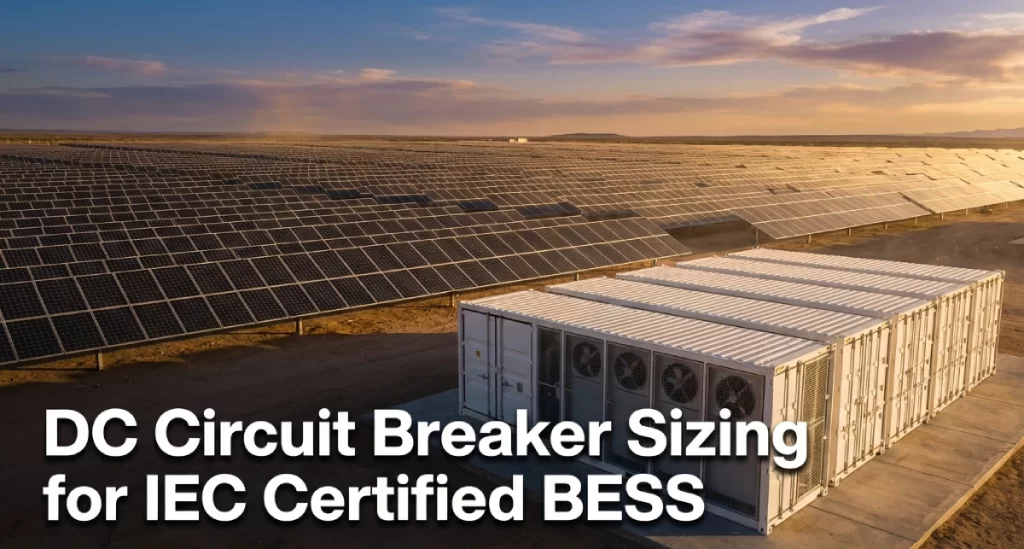
Understanding the Core Sizing Requirements of a DC Circuit Breaker
Understanding the core sizing requirements of a DC circuit breaker is vital to the safety and reliability of DC systems. This is applicable in applications such as the Battery Energy Storage System (BESS), where precise selection is crucial.
Unlike traditional AC power, direct current (DC) lacks a “zero crossing point,” making high-energy faults more difficult to extinguish. This could also lead to catastrophic damage or fire.
To ensure your system can safely handle these challenges, evaluate several core sizing requirements such as voltage rating, current sizing, interrupting capacity, and polarity.
Here are the factors to consider in choosing a battery protection component:
1. Voltage Rating
The most common error in choosing a BESS design is selecting a breaker based on its average battery voltage. For example, a 48V system often reaches more than 58.4V during peak charge. If the breaker’s operational voltage rating is too low (Ue), it will fail to stretch or accommodate an electrical arc during a fault. This allows the current to continue flowing even when the switch is open.
Engineers should follow the 20% Rule. This means selecting at least a 20% higher rating than the maximum charging voltage. For example, in a 48V nominal system with a 58V peak, the breaker should have headroom for at least 70V DC.
2. Current (Amperage) Sizing
There are instances when a circuit breaker trips unnecessarily. Oftentimes, this is due toa sensitive arc fault reacting to external factors such as minor electrical “noise.” This phenomenon is called “nuisance tripping.”
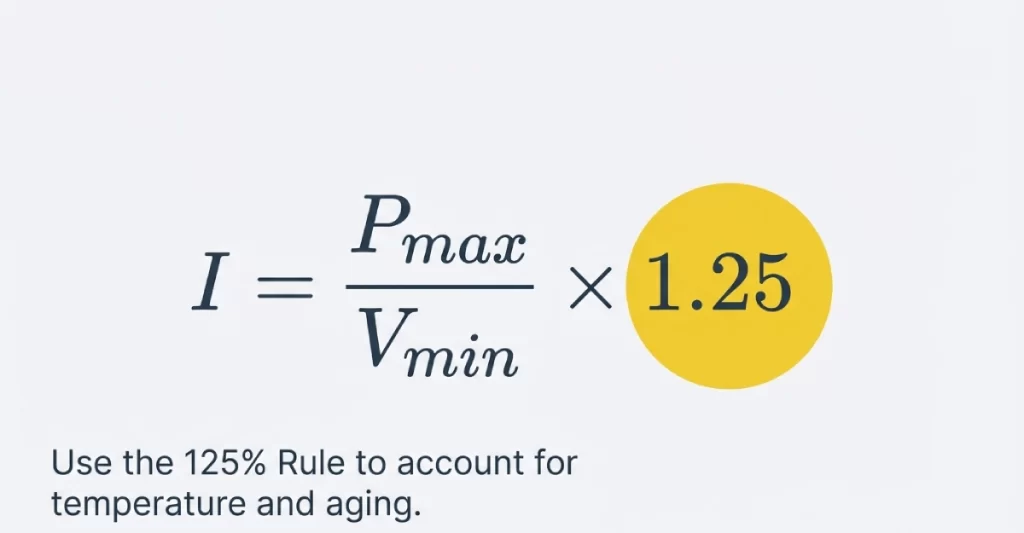
To prevent this from happening, breakers must have maximum headroom using the 125% Rule. This will account for ambient temperature fluctuations and component aging. Below is a simple calculation to follow:
Variable Definitions:
- EU: The required current rating for the breaker (in Amperes).
- Pmax: The maximum power output of the inverter (in Watts).
- Vmin: The lowest voltage the battery reaches before disconnecting (the “cutoff” voltage).
- 1.25: The safety factor (representing a 25% overhead to prevent “nuisance tripping” and account for heat).
Exemplo:
A 5kW inverter on a 48V system (discharging at 42V) pulls ~119A. Applying the 125% rule (119 x 1.25) results in a requirement of 148.75A, making a 150A or 160A breaker the appropriate choice.
3. Interrupting Capacity
The interrupting capacity refers to a breaker’s ability to safely extinguish an electrical arc without mechanical failure or contact welding. In battery storage applications, this is measured as the Rated Ultimate Short-Circuit Breaking Capacity (Icu) under IEC 60947-2 (for industrial use) or the Rated Short-Circuit Capacity (Icn) under IEC 60898-1 (for residential use).
Lithium-ion batteries have extremely low internal resistance. This means that they can discharge their entire chemical energy store in milliseconds during a fault. For a BESS, the DC circuit protection device must have a kA rating that exceeds the calculated peak fault current of the battery bank. IEC 60898-1 typically certifies residential breakers up to 6kA.
On the other hand, Industrial BESS installations often require IEC 60947-2 certified breakers with an Icu of 10kA to 50kA, depending on the battery chemistry and string configuration. Using a breaker with insufficient interrupting capacity can result in “arc-over.” This happens when the current continues to flow through the ionized air even after the contacts have separated.
4. Polarity: The Bi-directional Challenge
Standard DC breakers are often polarized. Polarity means they are designed to extinguish arcs only when current flows from positive to negative. However, BESS operations are bi-directional. This means that the current flows into the battery during charging and flows out when discharging.
The solution is to use IEC-certified non-polarized DC breakers to prevent fire hazards. These breakers use specialized magnetic fields to pull arcs into cooling chambers regardless of the current’s direction. This guarantees DC protection during both charge and discharge cycles.
Choosing the Right DC Protection for your Battery Storage System
Installers and engineers must decide carefully when scaling an energy project, especially when selecting non-polarized DC circuit protection for a BESS. Tosunlux offers a cost-effective, specialized “New Energy” line customized for residential and commercial establishments.
Below are some recommendations:
| Especificação | TOSUNLUX (TSB5 / TSM3 series) |
| Primary Application | Residential & Light Commercial BESS |
| Current Range | 6A to 800A |
| Max Voltage (Ue) | Up to 1000V (MCB) / 1500V (MCCB) |
| Interrupt Capacity | 6kA to 40kA |
| Polarity Type | Non-polarized available (Bi-directional) |
| Certificações | CE, TUV, IEC 60947-2 |
| Key Advantage | High value; specialized for PV/Storage |
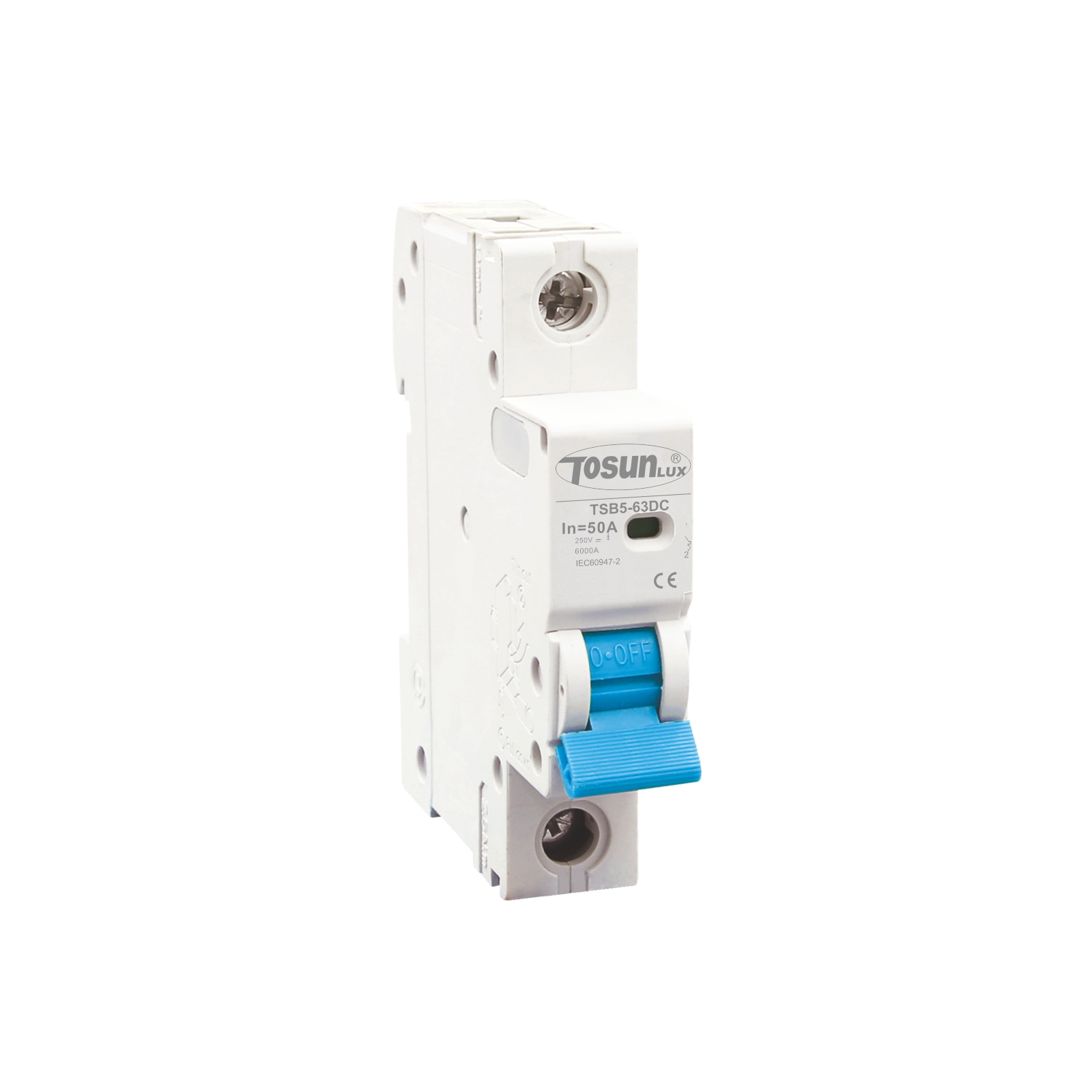
Selection Tip: For a standard48V residential system, a TOSUNLUX TSB5-63DC (non-polarized) is a common choice, certified for a minimum of 10,000 switching cycles. For utility-scale containerized storage exceeding 1000V.

Engineers’ Key Selection Checklist
As a solar installer, electrical engineer, or BESS project manager, your goal is to help protect the energy systems from the hazards of battery storage systems.
Before working on your next energy storage project, here is a checklist to verify the safety requirements:
- Maximum DC Voltage: The breaker rating must exceed the battery bank’s full charge voltage. Calculate maximum headroom by following the 20% rule.
- Continuous Current Rating: Calculate at 125% of maximum continuous load. Formula is: Inverter Peak x 1.25).
- Short-Circuit Interrupt Rating: The kiloamperes (kA) rating should exceed the worst-case fault current from your battery bank.
- Non-Polarized Design: The breaker should be rated for bi-directional current flow as evident in charge/discharge cycles.
- Standards Compliance: Confirm that the breakers are IEC certified and should meet IEC 60947-2 or IEC 60898-1 standards.
- Environmental Rating: Verify that humidity and temperature ratings are appropriate for your installation environment.
Conclusão
Procurando uma solução completa em iluminação LED?
Com 30 anos de experiência em fabricação certificada, somos o parceiro de confiança para todas as suas necessidades de iluminação industrial e comercial.
Selecting the right DC circuit breakers for your BESS or battery storage systems is fundamental to safety and longevity. Undersized voltage ratings may lead to arcing failures. Nuisance tripping may be caused by insufficient current ratings. These incidents may result in catastrophic breaker failure during fault conditions.
At Tosunlux, a manufacturer of electrical components and accessories, w e partner with you to ensure technical compliance and long-term performance. With over thirty (30) years of experience and a proven track record in global energy storage projects, we provide the confidence that your DC protection and energy systems will perform in crucial times.

Telefone: +86-577-88671000
E-mail: [email protected]
Skype: tosunelectric
Wechat: +86-139 6881 9286
WhatsApp: +86-139 0587 7291
Endereço: Sala No.1001 Wenzhou Fortune Center, Station Road, Wenzhou, China
SOLICITE UM ORÇAMENTO
Mande-nos uma mensagem pelo WhatsApp