blog

  • Tendências do mercado de chaves de transferência para energia de reserva e aplicações industriais

    07th dez 2025

    The transfer switch market is projected to grow from USD 2.6 billion in 2024 to USD 4.7 billion by 2034 at a 6% CAGR, driven by increasing grid instability, expanding data center infrastructure, and rising demand for modular backup power systems, according to Global Market Insights and Market Research Future. Grid Instability Creates Urgency for Backup Solutions Power outages are happening more often due to aging infrastructure and extreme weather patterns. If you run a hospital, data center, or manufacturing plant, even a few minutes without power can mean substantial financial losses. Transfer switches handle the transition between grid power and generator systems when outages occur. Automatic units monitor utility power continuously and switch to backup within seconds when they detect failures, which eliminates the need for manual intervention. The automatic segment alone is expected to surpass USD 2.9 billion by 2034. These devices respond faster than human operators can, which matters when you’re protecting sensitive equipment or life-critical systems. North America leads with approximately 40% market share, pushed by high energy consumption and weather-related grid disruptions. Regulatory standards in the U.S. require backup power for hospitals and emergency systems, which creates consistent demand. What’s pushing market expansion: Comparing Automatic and Manual Options The ATS vs manual question comes down to your specific needs and budget. Automatic systems capture over 60% of the market because they react within milliseconds and don’t depend on someone being available to flip switches. If you’re managing critical infrastructure, automatic units detect outages before equipment feels the impact. That can […]

    consulte Mais informação
  • Crescimento e aplicações do mercado global de relés de estado sólido

    05 de dezembro de 2025

    The solid state relay market is projected to grow from USD 1.4 billion in 2025 to USD 1.8 billion by 2035 at a 2.3% CAGR, driven by increasing automation in industrial sectors and rising demand for efficient switching solutions in solar PV systems, according to market research from Future Market Insights and Data Bridge Market Research. Industrial Automation Drives Primary Demand Industrial automation represents the largest application segment for solid-state relays. If you’re upgrading legacy control systems to Industry 4.0 standards, SSRs offer critical advantages: no mechanical wear, silent operation, and faster switching speeds. Manufacturing facilities running continuous operations need components that can handle high-cycle switching without degradation. An SSR relay can perform millions of switching cycles compared to thousands for mechanical alternatives. That means significantly lower maintenance costs over the equipment’s lifespan. Panel mount SSRs currently hold 46.0% of the market by packaging type. Their modular design facilitates quick replacement within control panels. If you’re managing automation systems that can’t afford extended downtime, this modularity becomes essential rather than optional. Primary industrial applications include: The shift toward smart factories is accelerating adoption. When you integrate SSRs with PLCs and building management systems, it means you gain real-time monitoring that enables predictive maintenance. Solar PV Systems Fuel Growth Trajectory Renewable energy installations, particularly solar photovoltaic systems, represent a fast-growing segment. SSRs play a crucial role in solar inverters and battery energy storage systems where reliable switching under varying load conditions is essential. A high frequency solid state relay handles the rapid switching required in solar […]

    consulte Mais informação
  • Por que os sistemas de medição de energia estão se tornando essenciais nas redes elétricas modernas?

    03rd dez 2025

    Energy metering systems are essential because they provide real-time data and two-way communication that enable grid operators to manage renewable energy integration, optimize efficiency, reduce outages, and support dynamic pricing in modern electrical networks. Real-Time Monitoring Improves Grid Stability Traditional grids relied on manual meter readings and one-way power flow. Detecting faults meant waiting for customer reports or sending technicians to investigate manually. Real-time data collection changed this. Utilities can now monitor system conditions as they happen, which cuts fault detection time significantly and enables remote service restoration. The smart energy meter infrastructure alerts operators the moment anomalies occur. Compare this to older systems where issues went undetected until customers called to report outages. Real-time monitoring delivers: Managing Renewable Energy and Distributed Generation Modern grids face a challenge traditional infrastructure wasn’t built to handle: bidirectional power flow. Solar and wind generate intermittent power that doesn’t follow predictable patterns. Advanced metering systems handle this through two-way measurement. They track power flows dynamically, which lets utilities balance fluctuating supply and demand in real time. If you generate your own power through rooftop solar, smart meters measure electricity flowing both ways. You consume power from the grid during low-sun periods, then export excess during peak production. The meter tracks both, which means you get accurate credits for what you send back. Optimizing Energy Consumption and Costs A digital power meter records consumption in 15 to 60 minute intervals. Cumulative readings hide inefficiencies, but granular data exposes them clearly. Real-time information changes behavior. When you see exactly what your […]

    consulte Mais informação
  • Global DC Circuit Breaker Market Analysis for Solar and Industrial Applications

    01st dez 2025

    The global DC circuit breaker market is projected to grow from USD 4.92 billion in 2024 to USD 9.13 billion by 2032 at a 7.81% annual rate, driven primarily by solar PV expansion, electric vehicle adoption, and industrial DC system modernization, based on data from Fortune Business Insights. Solar PV Expansion Drives Primary Growth Solar installations are accelerating worldwide. The International Energy Agency’s Renewables 2023 report showed global renewable capacity grew 50%, reaching nearly 510 GW, with solar PV accounting for three-quarters of new installations. China added as much solar capacity in 2023 as the entire world did in 2022. Europe, the U.S., and Brazil all achieved record-high deployment levels during the same period. Key market growth drivers include: Why DC Protection Requires Specialized Solutions Unlike AC systems, direct current circuit breakers face a fundamental technical challenge. DC arcs don’t have natural zero-crossing points. When you interrupt an AC circuit, the current naturally passes through zero 100 or 120 times per second. That means arc extinction happens relatively straightforward. DC current flows continuously in one direction, so once an arc forms during circuit interruption, it sustains itself. This creates serious risks like equipment damage and fire hazards. These challenges require breakers engineered specifically for DC applications, with sophisticated arc management techniques like magnetic blow-out coils and hybrid switching mechanisms. Our guide to DC circuit breaker operation explains how these technologies safely interrupt DC current under various fault conditions. Industrial Applications Beyond Solar Energy Solar systems generate electricity in DC form. Before that power reaches your […]

    consulte Mais informação
  • Guia completo dos componentes do sistema de distribuição de energia

    20 de novembro de 2025

    Power distribution components include substations, transformers, distribution lines, protective devices, and control equipment. These work together to deliver electricity safely from the grid to end users. These systems rely on circuit breakers and monitoring equipment to maintain reliable power flow. What Are Power Distribution System Components? A power distribution system receives high-voltage electricity from the transmission grid. It then converts this power to usable voltage levels. The system distributes electricity across multiple circuits while protecting equipment from faults. Component Type Primary Function Typical Voltage Range Common Applications Substations Voltage reduction and control 66kV to 11kV Grid interface points Transformers Voltage transformation 11kV to 120/480V Distribution to end users Distribution lines Power transmission 11kV to 400V Feeders, distributors, service mains Protective devices Fault detection and isolation All voltage levels System protection Switchgear Control and switching 600V to 38kV Power distribution control Substations: The Voltage Reduction Hubs Substations are facilities where transmission voltage is reduced to distribution levels. A typical substation receives power at 66kV or 132kV. It steps this down to 11kV or 33kV for local distribution networks. You’ll find power transformers handling the voltage conversion. Circuit breakers provide switching capability and fault protection. Switchgear assemblies control power flow to different feeders. Protective relays monitor conditions and trigger breakers when problems develop. Modern substations utilize automation to detect faults and restore power more efficiently. Transformers in Distribution Systems Transformers change voltage levels at multiple points throughout the distribution network. Different types serve specific functions. Distribution Transformers Distribution transformers reduce primary distribution voltage to levels that consumers […]

    consulte Mais informação
  • Normas Essenciais: Por que os Disjuntores Diferenciais Residuais Tipo B são Fundamentais para Aplicações Industriais Específicas

    20 de novembro de 2025

    Type B RCCBs are essential because they detect smooth DC fault currents that standard devices cannot see. When power electronics create DC leakage, Type AC and Type A RCCBs get blinded and fail to trip.Type B units use specialized detection technology that works across all fault current types. What is a Type B RCCB? A Type B RCCB is a residual current circuit breaker that detects AC, pulsating DC, and smooth DC fault currents. Type AC devices only detect alternating currents. Type A devices handle AC and pulsating DC. Type B is the only option that detects smooth DC currents from power electronics. Type B RCCBs use flux-gate detection technology instead of the standard core transformer design. This technology prevents magnetic saturation that blinds other RCCB types. The device maintains sensitivity across all fault current waveforms including high-frequency AC components and smooth DC currents. Comparing RCCB Types RCCB Type Detects AC Currents Detects Pulsating DC Detects Smooth DC Common Applications Type AC Yes No No Basic lighting, standard outlets Type A Yes Yes No Residential appliances, computers, LED lights Type B Yes Yes Yes VFDs, EV charging, solar systems, industrial equipment The RCCB Type A vs Type B difference comes down to smooth DC fault detection. Why Standard RCCBs Fail with Power Electronics Standard RCCBs use a core transformer that monitors current balance between live and neutral wires.Normal operation keeps these currents equal with no net magnetic field. Faults create imbalances that generate a magnetic field in the transformer core. When the field reaches a […]

    consulte Mais informação
  • Tudo o que você precisa saber sobre acessórios elétricos

    13 de novembro de 2025

    Electrical accessories are the small components that support wiring and installation work. Some of the common ones include conduits, cable glands, terminal blocks and junction boxes. These components protect wiring and help create reliable, structured electrical installations. Why Electrical Accessories Matter Electrical accessories support the entire wiring system. They guide cables where they need to go and keep every connection firm and protected once the installation is powered on. The right accessories also prevent unnecessary strain on the wiring and reduce the chance of loose or unstable connections over time. The result turns out beneficial: Quick Overview: Electrical Accessories by Function Category Accessories Main Function Cable routing & management Conduit, wiring duct, cable gland, DIN rail, cable clamp Protect and guide cables Connection & termination Terminal block, cable lug, insulated terminals Secure wire connections Enclosure & installation Junction box, waterproof enclosure, panel hardware Protect components Control & indication Push button, indicator lamp, timer, float switch Operate or signal equipment Safety & testing Voltage tester, smoke sensor, capacitor Improve system reliability Cable Routing and Management This category includes accessories that define how cables are laid out and supported during installation. Examples include: PG Cable Gland Secure Cable Entry Point Sealing Prevents Dust and Moisture Intrusion Integrated Strain Relief Mechanism Durable Polyamide Construction View Details & Specs Connection and Termination Once cables reach their final destination, the focus shifts to making solid electrical contact. Below are the accessories that hold wires firmly in place and keep current flowing without hot spots or loose joints. SC-1 Copper Cable […]

    consulte Mais informação
  • Os 5 principais benefícios da fita isolante de PVC

    13 de novembro de 2025

    PVC insulation tape gives installers more control over their wiring work. You can use it to wrap and protect cable joints so connections stay safe after installation. Other benefits include keeping cable runs organized and making phase identification quick during maintenance. What is PVC Tape? PVC tape is an electrical tape used to cover and protect wire connections. It forms an insulated layer around cable joints to prevent exposed conductors from making contact. The tape also keeps wiring tidy and easier to manage during installation. Benefits of Using PVC Insulation Tape So what are the advantages of using PVC insulation tape? Here are five advantages that matter on every job site. 1. Reliable insulation for electrical work PVC insulation tape keeps exposed conductors covered so connections stay safe after installation. It provides a protective layer around cable joints and terminals, reducing the risk of short circuits or current leakage. Contractors trust PVC tape for electrical insulation because: If you have multiple roll sizes on site, a PVC insulation tape jumbo roll saves time on larger projects since you do not have to replace rolls often. PVC Insulating Tape Reliable Electrical Insulation Self-Extinguishing Flame Retardant High Adhesion & Moisture Resistant Available in Multiple Colors for Phasing View Details & Specs 2. Resistant to moisture and abrasion Electrical connections are often exposed to humidity and friction from nearby metal surfaces. PVC insulation tape holds up in these conditions because it resists moisture and surface wear. Once wrapped, it forms a protective seal so the insulation stays intact […]

    consulte Mais informação
  • Como escolher o bloco de terminais correto

    12 de novembro de 2025

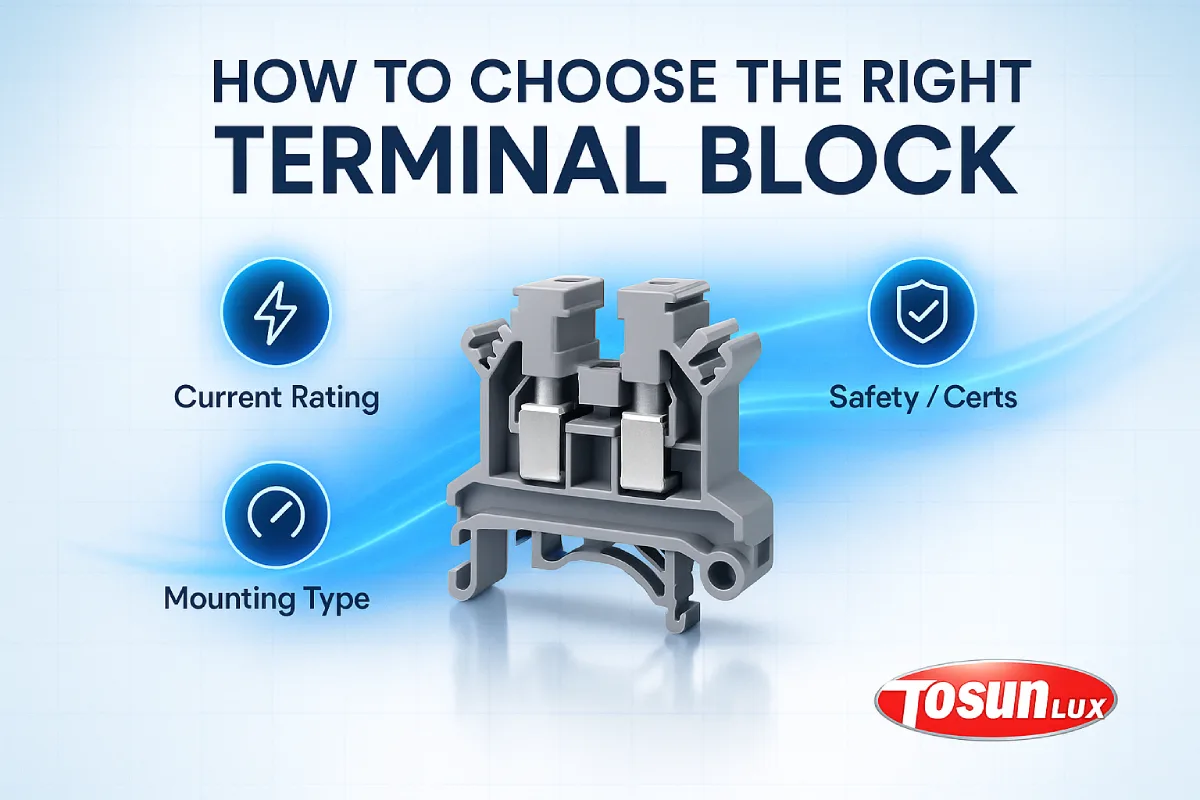
    Escolher o bloco de terminais correto exige que as classificações de tensão e corrente sejam compatíveis com os requisitos do seu sistema, que você selecione um estilo de entrada de fios apropriado e considere o método de montagem. Certifique-se de que a capacidade de bitola do fio seja compatível com seus condutores e verifique se o bloco atende aos padrões de segurança relevantes para sua aplicação. O que os blocos de terminais fazem? Os blocos de terminais criam conexões seguras e organizadas entre os fios sem a necessidade de emendas permanentes. Eles usam fixação mecânica para manter os condutores unidos dentro de uma caixa isolada. Você os encontrará em equipamentos industriais onde a fiação de controle precisa de pontos de conexão organizados. Como os blocos de terminais funcionam? Um bloco de terminais prende os condutores dos fios contra terminais de metal usando força mecânica. Insira um fio na abertura do terminal e aperte o mecanismo de fixação. Isso cria uma conexão hermética que conduz eletricidade de forma confiável, mantendo o condutor firmemente no lugar. A caixa isolada mantém as conexões adjacentes separadas. Você pode conectar vários fios ao mesmo bloco sem criar contato direto entre os circuitos. Isso permite que você inspecione ou modifique conexões individuais sem afetar as outras. Tipos de blocos de terminais Os blocos de terminais variam de acordo com o método de montagem, o estilo de entrada de fios e o mecanismo de fixação. Aqui estão os principais tipos: Como escolher o bloco de terminais correto? Escolher um bloco de terminais fica mais fácil quando você avalia os fatores em ordem. Veja o que considerar: Bloco de Terminais Modular (UK) Montagem em Trilho DIN Modular Carcaça de Alto Isolamento (PA66) Conexão Segura com Parafusos Certificado pela IEC para Confiabilidade Veja Detalhes e Especificações Passo 1: Calcule os Requisitos de Corrente e Tensão Comece calculando a corrente máxima que seu circuito suportará. Selecione um bloco de terminais […]

    consulte Mais informação
  • Qual a diferença entre um bloco de terminais e uma régua de terminais?

    12 de novembro de 2025

    The main difference between a terminal block and a terminal strip is how they are structured. A terminal block is modular and insulated, allowing you to add or remove sections on a DIN rail. A terminal strip, meanwhile, is one fixed row of screw terminals used for simple wire-to-wire connection. What Is a Terminal Block? The best way to define terminal block is to see it as a modular connector that secures two or more wires inside an insulated housing. Inside the block, a metal conductor transfers current while a clamping mechanism (screw, spring, or push-in) holds the wire firmly in place. It gives you a safe wiring point without permanent splicing. What Is a Terminal strip? A terminal strip is a single fixed row of screw terminals used to connect wires point-to-point. Each section has a metal conductor with a screw on top, allowing the wire to be fastened securely. Unlike a modular terminal block, a terminal strip comes as one long piece and does not mount on a DIN rail. It is mainly used for simple wiring connections where circuits do not need frequent changes. How Are Terminal Blocks and Terminal Strips Different? The simplest way to compare terminal strip vs terminal block is by looking at structure, flexibility, and safety. The table below shows how each functions in an electrical setup. Terminal Block vs Terminal Strip (Quick Comparison) Category Terminal Block Terminal Strip Structure Modular connector with individual insulated terminals Single fixed strip with multiple screw terminals in one piece Wiring Flexibility […]

    consulte Mais informação
Carregando...