 : +86-139 0587 7291
 Inglés
 Español
 Ruso
Ruso Francés
 árabe
árabe Portugués de Brasil
 Ucraniana
 Turco
Turco Polaco
 Países Bajos
 italiano
 Lenguaje indonesio
 Hindi
Hindi árabe
árabe አማርኛ
አማርኛ Հայերեն
 Sí
Sí Mongol
 فارسی
فارسی Chisme
 Elogio

Explicación de los tipos de MCCB: Tipos B, C, D, K, Z: cómo funciona cada uno y cuándo utilizarlos.
Tabla de contenidos
PalancaExisten diferentes tipos de disyuntores y es necesario saber cómo funcionan para poder instalarlos correctamente. Estos disyuntores se agrupan en diferentes tipos: tipo B, tipo C, tipo D, tipo K y tipo Z. Un MCCB tipo B se disparará cuando detecte una sobretensión de 3 a 5 veces la corriente nominal, mientras que un tipo C lo hará. viaje cuando vea un aumento de 5 a 10 veces.
Un MCCB es un excelente dispositivo de protección eléctrica. Su carcasa está sellada y no se puede abrir. Pero como cualquier otro equipo eléctrico, requiere un mantenimiento periódico para poder funcionar correctamente.
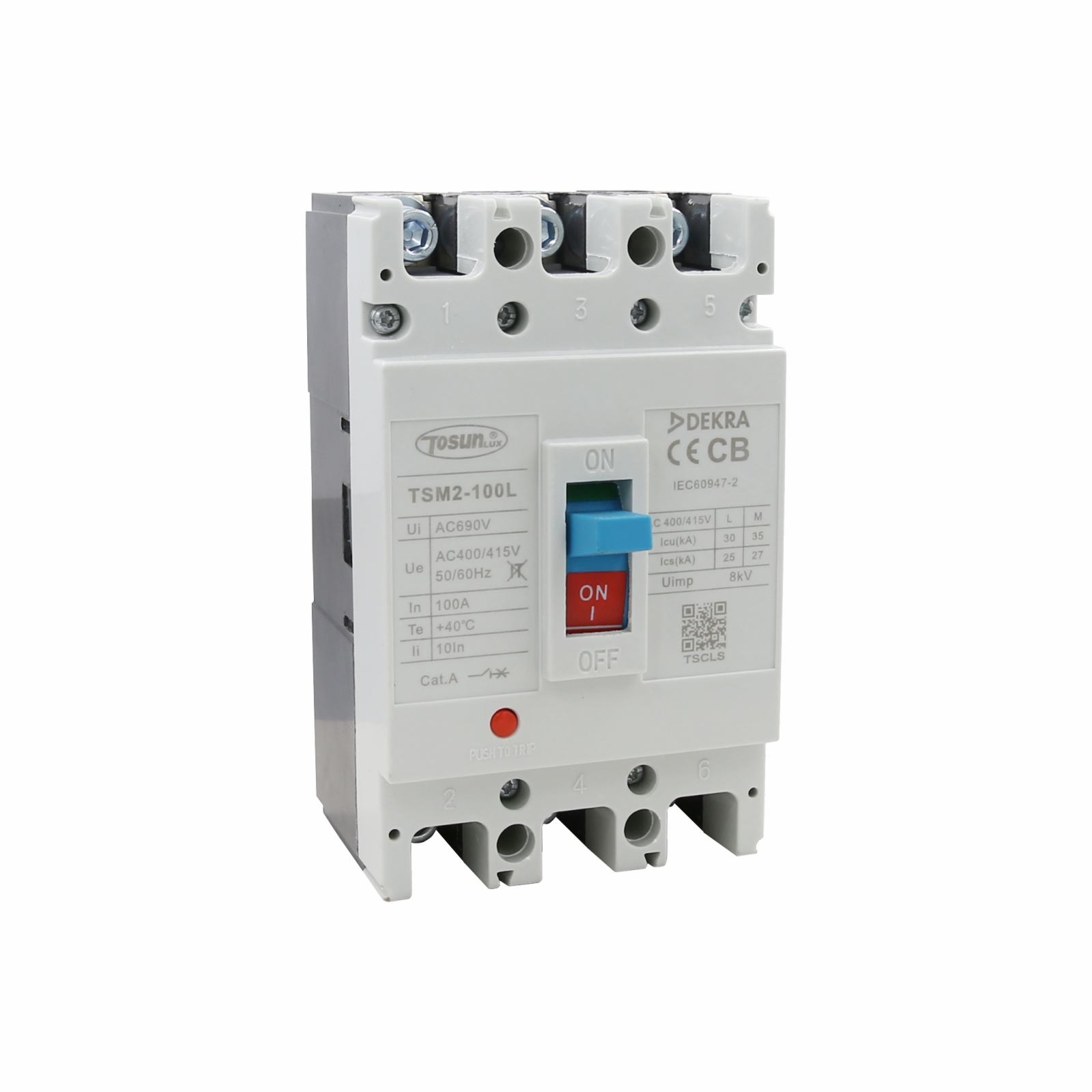
Los MCCB pueden manejar una gran corriente y un cortocircuito. También tienen una unidad de disparo móvil y un tiempo de disparo corto. Algunos tipos tienen funciones de encendido/apagado remoto, lo que los hace útiles en entornos industriales donde las descargas eléctricas son un peligro común.
Diferente tipos de MCCB se utilizan en diferentes entornos eléctricos. Si quieres conocer los diferentes tipos de MCCB y cómo funcionan, continúa leyendo este artículo.

¿Cómo funciona un MCCB?
Los interruptores automáticos de distribución están diseñados para interrumpir automáticamente el flujo de electricidad cuando se detecta una falla. Constan de varios componentes clave, como la unidad de disparo del relé, componentes sensibles a la temperatura como la tira bimetálica y contactos de arco. La combinación de estas características permite que el interruptor automático de distribución responda a las sobrecargas y cortocircuitos desconectando rápidamente el circuito defectuoso, lo que garantiza la seguridad eléctrica.
Unidad de disparo de relé:Este es el cerebro del MCCB. Incluye una bobina electromagnética y un émbolo de disparo que activa el disyuntor cuando se detecta una falla. El sistema puede disparar el disyuntor inmediatamente o con un retraso, según la gravedad de la falla.
Tira bimetálica:Este componente se expande cuando la corriente excede el límite seguro, lo que hace que se doble y, finalmente, active el disyuntor. Ayuda a proteger contra condiciones de sobrecarga prolongada.
Contactos de arco: These contacts are responsible for interrupting the electrical arc that forms when the breaker trips. Their quick response minimises the risk of fire and further damage.
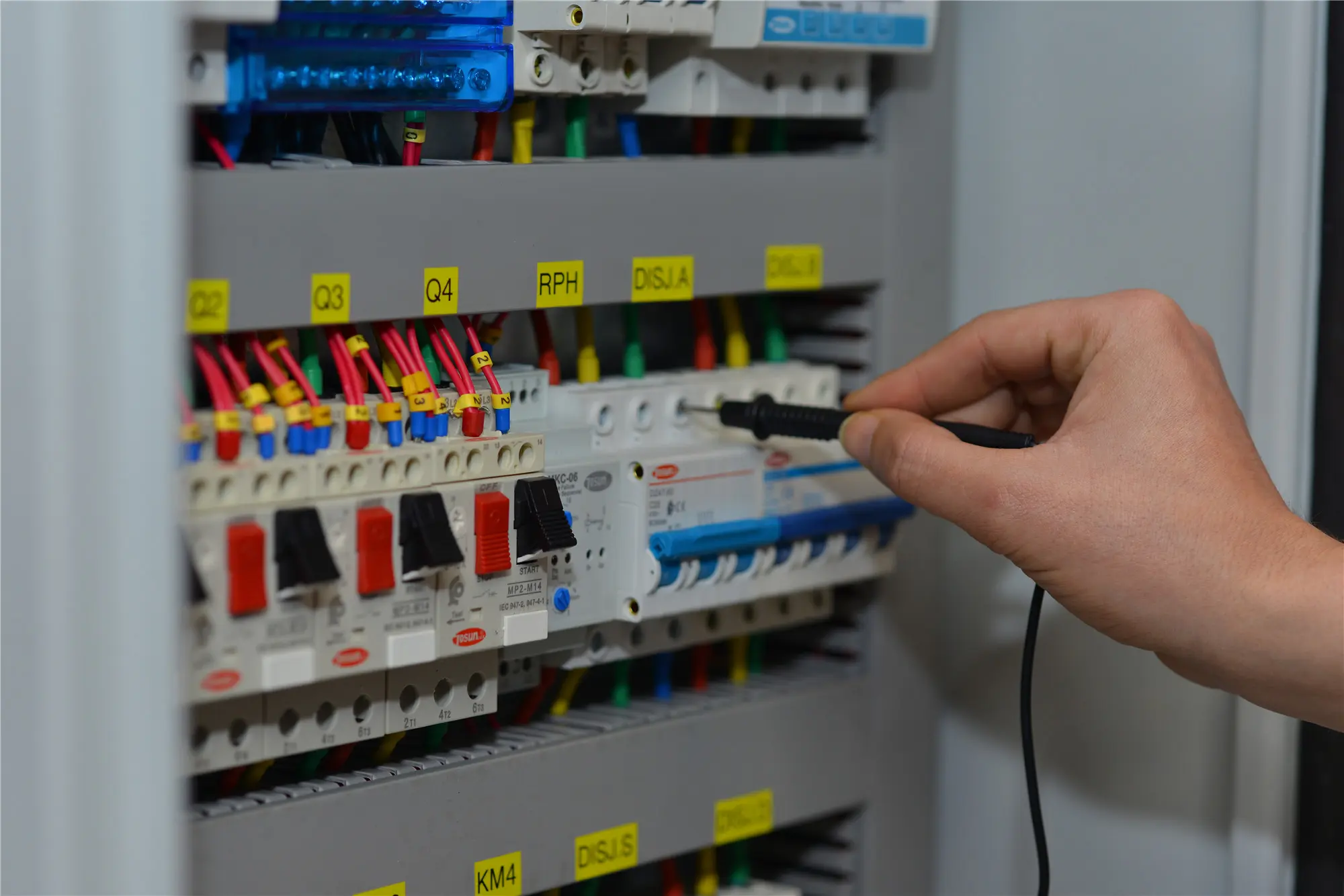
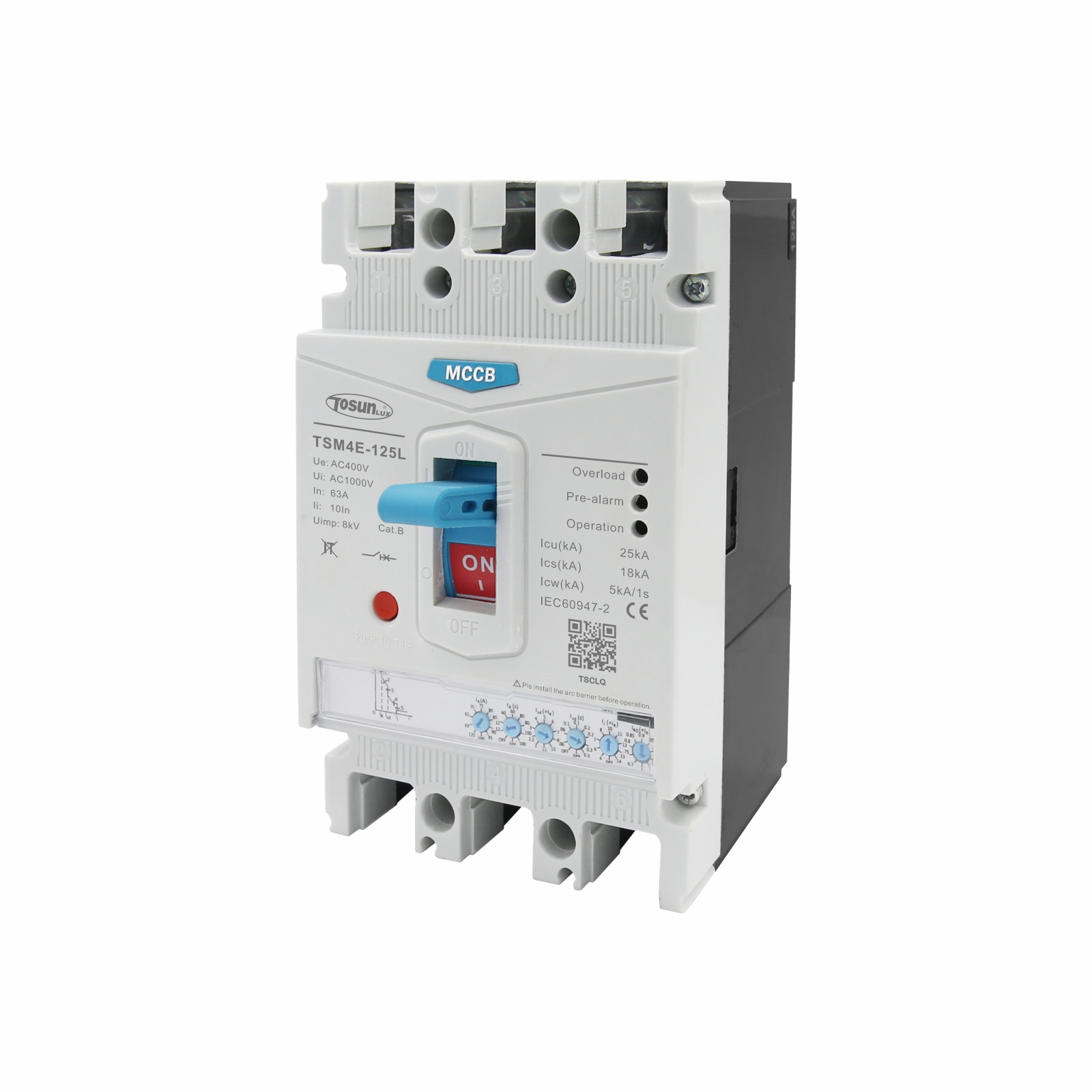
By using these components, MCCBs provide comprehensive protection in a wide range of electrical systems. For installations requiring adjustable tripping characteristics, the TSM4E Electronic Type Moulded Case Circuit Breaker allows engineers to fine-tune protection settings directly to the circuit’s specific load profile.

MCCB Type Comparison: Tripping Ranges and Applications at a Glance
Selecting the correct MCCB type begins with understanding how each one responds to overcurrent events. The table below summarises the five standard MCCB types, their tripping current ranges, and the applications they are best suited for. Use this as a quick reference before consulting the detailed descriptions that follow.
MCCB Type Comparison: Tripping Ranges and Applications at a Glance
Selecting the correct MCCB type begins with understanding how each one responds to overcurrent events. The table below summarises the five standard MCCB types, their tripping current ranges, and the applications they are best suited for. Use this as a quick reference before consulting the detailed descriptions that follow.
| Tipo | Trip range | Typical use case | Inrush tolerance |
|---|---|---|---|
| Tipo B | 3–5× rated current | Residential lighting, small appliances | Bajo |
| Tipo C | 5–10× rated current | Commercial & general industrial (motors, transformers) | Moderado |
| Tipo D | 10–20× rated current | Heavy industrial machinery, frequent start/stop | Alto |
| Tipo K | 8–12× rated current | Sensitive equipment, dual-cable circuits | Moderate–high |
| Tipo Z | 2–3× rated current | Telecom, data centers, sensitive electronics | Telecom, data centres, sensitive electronics |
Elegir el tipo correcto de MCCB
La elección del interruptor automático de distribución depende de las necesidades eléctricas específicas del sistema. A continuación, analizamos los distintos tipos de interruptores automáticos de distribución, cada uno diseñado para manejar distintos niveles de corriente y tiempo de respuesta.
Interruptores MCCB tipo B
Type B moulded case circuit breakers are designed for residential and light commercial applications where inrush currents are low. They trip at 3 to 5 times the rated current, making them well-suited for protecting lighting circuits, socket outlets, and small household appliances. They trip at 3 to 5 times the rated current. These breakers are ideal for protecting circuits with low inrush currents, such as lighting and small appliances.
Interruptores MCCB tipo C
Type C MCCBs are the most widely used moulded case circuit breakers in general commercial and industrial settings. With a tripping range of 5 to 10 times the rated current, they handle moderate inrush currents from equipment such as motors, pumps, and transformers without nuisance tripping. They are suitable for general-purpose use in commercial and industrial applications. Type C breakers are commonly used in systems that involve equipment with moderate inrush currents, such as motors and transformers. The TSM2 Moulded Case Circuit Breaker is a dependable Type C-rated solution for commercial and light industrial installations, offering high performance overload and short circuit protection in a compact sealed casing.
Interruptores MCCB tipo D
Type D moulded case circuit breakers are engineered for heavy industrial environments where large machinery generates high inrush currents on startup. They trip at 10 to 20 times the rated current, providing reliable short circuit protection without interrupting normal operation of equipment like compressors, welding machines, and industrial presses. Type D breakers trip at 10 to 20 times the rated current and are best used in environments where substantial equipment starts and stops frequently. Their higher tolerance to inrush currents makes them ideal for heavy-duty operations. For demanding heavy-duty environments, the TSM9 Moulded Case Circuit Breaker provides robust protection against overload, short circuit, and under-voltage conditions in AC 50/60Hz industrial circuits.
Interruptores MCCB tipo K
Type K MCCBs offer enhanced protection for circuits carrying sensitive equipment or installations with two cables. Tripping at 8 to 12 times the rated current, they balance tolerance for surge currents with fast response to genuine faults, making them a preferred choice where standard Type C protection is insufficient.They trip at 8 to 12 times the rated current and are often used in settings where more sensitive equipment is involved. Type K breakers are ideal for providing enhanced protection in installations where surge currents are common.
Interruptores MCCB tipo Z
Type Z moulded case circuit breakers are the most sensitive type available, tripping at just 2 to 3 times the rated current. They are specifically designed to protect delicate electronic equipment in telecommunications infrastructure, data centres, and precision measurement systems where even minor overloads can cause irreversible damage. They are used to protect sensitive electronic equipment, making them suitable for applications like telecommunications and data centers. While they are not as versatile as other types, their ability to react to small overloads makes them an essential component in sensitive circuits.
Soluciones MCCB confiables a precios competitivos: ¡solicite su cotización hoy!
Consideraciones clave a la hora de elegir un MCCB
Al seleccionar el MCCB adecuado, tenga en cuenta los siguientes factores:
- Valoración actual:Asegúrese de que la clasificación de corriente del MCCB coincida con la carga esperada del circuito para evitar disparos innecesarios o protección insuficiente.
- Tipo de aplicación:Los distintos tipos de interruptores automáticos de distribución se adaptan a distintos entornos, como entornos residenciales, comerciales o industriales. Comprender su aplicación le ayudará a elegir el interruptor automático de distribución de energía adecuado.
- Tiempo de respuesta:Elija un MCCB con el tiempo de respuesta correcto para garantizar que se dispare rápidamente durante condiciones de sobrecarga o cortocircuito.
Preguntas frecuentes: Preguntas frecuentes sobre los MCCB
Q1: ¿Cuál es la diferencia entre MCCB y MCB?
A1:Si bien ambos sirven para proteger los circuitos contra sobrecargas y cortocircuitos, los MCCB pueden manejar corrientes más altas y se utilizan a menudo en aplicaciones industriales. Los MCB se utilizan generalmente en aplicaciones residenciales y comerciales ligeras.
P2: ¿Se puede reiniciar un MCCB?
A2: Sí, una vez que se dispara un MCCB, se puede restablecer manualmente. Sin embargo, es importante investigar la causa de la activación antes de restablecer el disyuntor.
P3: ¿Con qué frecuencia se debe realizar el mantenimiento de los MCCB?
A3:El mantenimiento periódico es esencial para garantizar el correcto funcionamiento del interruptor automático. Esto incluye la limpieza, la comprobación de signos de desgaste y la verificación del funcionamiento del mecanismo de disparo.
P4: ¿Para qué se utiliza un MCCB tipo D?
A4:Los interruptores automáticos de tipo D están diseñados para aplicaciones industriales pesadas donde las corrientes de entrada elevadas son comunes. Ofrecen protección para máquinas y motores grandes.
Q5: What is the typical lifespan of an MCCB?
A5: Under normal operating conditions, an MCCB can last 20 years or more. However, its mechanical and electrical life is also rated by the number of operations — typically between 10,000 and 25,000 switching cycles depending on the model and manufacturer. Regular maintenance, avoiding repeated short-circuit trips, and operating within the rated current range all contribute to a longer service life.
Q6: Can an MCCB be used as a main switch or isolator?
A6: Yes, many MCCBs are approved for use as a main switch or isolator when they carry the appropriate certification for that function. However, not all MCCBs are rated for isolation duty — always check the product datasheet to confirm whether the unit meets the isolation requirements specified in IEC 60947-2 or the relevant local standard before using it in this role.
Q7: What are the most common causes of MCCB failure?
A7: The most frequent causes include repeated exposure to short-circuit currents beyond the breaker’s rated capacity, mechanical wear from excessive switching operations, moisture or contaminant ingress into the casing, and loose terminal connections that cause localised overheating. Scheduled inspection and testing — including contact resistance checks and insulation resistance testing — help identify early signs of degradation before failure occurs.

Mejora de la seguridad eléctrica con interruptores automáticos de distribución
Los interruptores automáticos de distribución son indispensables para mantener la seguridad eléctrica en una amplia gama de aplicaciones. Al seleccionar el tipo adecuado para sus necesidades, puede garantizar la protección de los circuitos eléctricos y reducir el riesgo de daños o incendios. El mantenimiento regular y la instalación adecuada mejoran aún más la confiabilidad y la eficacia de los interruptores automáticos de distribución.
For a detailed side-by-side breakdown, read our guide on MCCB vs MCB: key differences in current rating, application type, and protection level.
🔎 Lectura recomendada sobre tipos de MCCB y principio de funcionamiento
Los diferentes tipos de MCCB y cómo funciona
Aprenda sobre los distintos tipos de disyuntores de caja moldeada (MCCB), su construcción y cómo brindan protección en los sistemas eléctricos.
Ventajas de utilizar disyuntores de baja tensión
Descubra por qué los MCCB son esenciales en los sistemas de bajo voltaje y cómo mejoran la seguridad y la confiabilidad en la distribución eléctrica.
Capacidad de corte vs. clasificaciones de disyuntores
Comprenda cómo evaluar las clasificaciones y capacidades de corte del MCCB para elegir el nivel de protección adecuado para su sistema.
Teléfono: +86-577-88671000
Correo electrónico: ceo@tosun.com
Skype: tosunelectric
WeChat: +86-139 6881 9286
WhatsApp: +86-139 0587 7291
Dirección: Sala n.º 1001 Wenzhou Fortune Center, Station Road, Wenzhou, China
SOLICITAR PRESUPUESTO
Envíanos un WhatsApp