 : +86-139 0587 7291
 English
 Español
 Русский
 Français
 العربية
 Português do Brasil
 Українська
 Türkçe
 Polski
 Nederlands
 Italiano
 Bahasa Indonesia
 हिन्दी
 اردو
اردو አማርኛ
አማርኛ Հայերեն
 ไทย
ไทย Монгол
 فارسی
فارسی Shqip
Shqip Ελληνικά

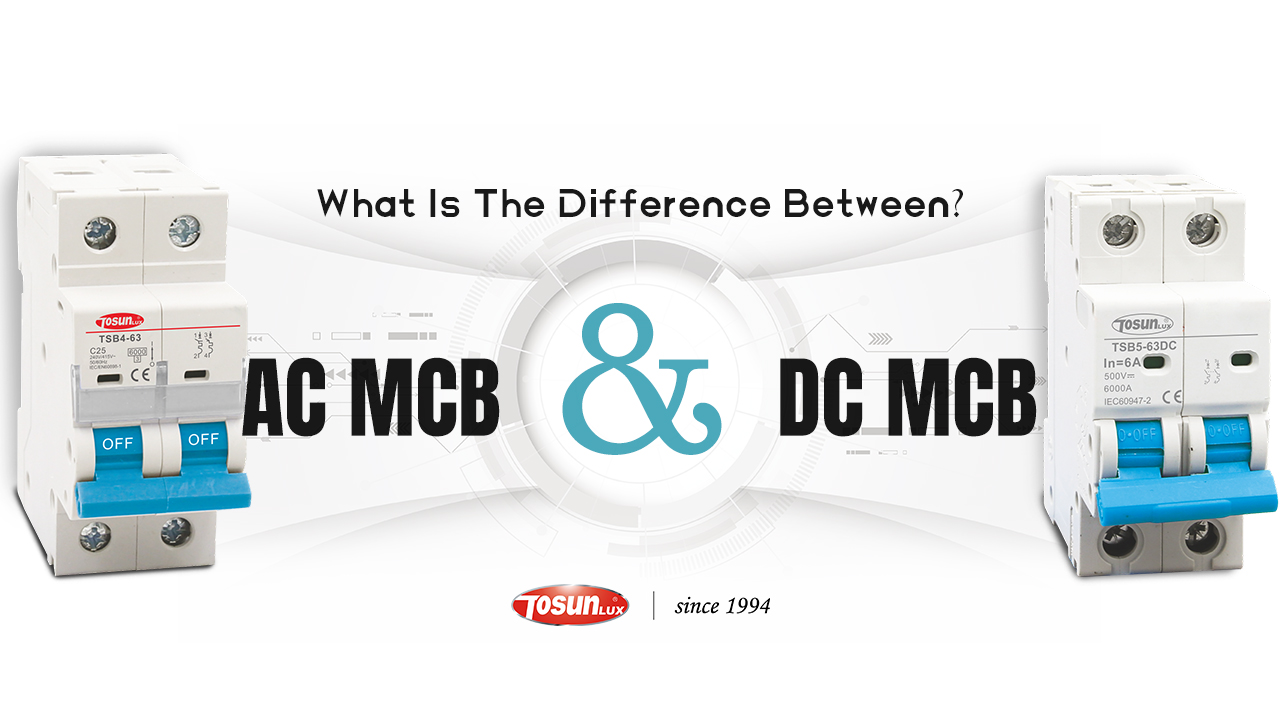
What Is the Difference Between AC MCB And DC MCB?
Table of Contents
ToggleAC MCBs and DC MCBs may look similar, but they are not designed for the same electrical conditions.
The difference is not only the current type. Arc interruption, polarity, breaking behavior, and application environment all affect whether the breaker is suitable for the circuit.
For buyers, the most important point is simple: an AC breaker should not be selected for a DC circuit just because the current rating looks similar. This guide explains the practical difference and when each type should be used.
Key Differences Between AC MCB and DC MCB
The following table highlights the main differences between AC and DC MCBs based on structure, applications, and technical specifications:
| Feature | AC MCB | DC MCB |
| Current Type | Alternating Current (AC) | Direct Current (DC) |
| Arc Suppression | Handles arc interruption more easily | Requires larger arc suppression mechanism |
| Applications | Used in homes, offices, and AC circuits | Suitable for solar, battery, and DC circuits |
| Breaking Capacity | Lower, due to easier arc suppression in AC | Higher, to manage steady DC current |
| Polarity Sensitivity | Not polarity sensitive | Polarity sensitive |
| Lifespan | Longer in AC due to arc dissipation | Shorter as DC arcs wear components faster |
How to Choose the Right Breaker for the Application
Choose an AC MCB for standard low-voltage AC distribution circuits in homes, commercial buildings, and general industrial panels.
Choose a DC MCB for solar applications, battery energy storage systems, DC combiner boxes, and other circuits where the load and source are both direct current.
Before ordering, confirm the system voltage, current, number of poles, installation layout, and the breaker’s rated application category. In DC systems, these details matter more because the interruption conditions are more demanding.
Design and Functional Differences Between AC and DC MCBs
Arc Suppression
In AC systems, the current naturally crosses zero, making it easier to control the arc formed when a circuit is interrupted. An AC MCB is designed with this zero-crossing in mind, so arc suppression is less demanding.
In contrast, DC MCBs need larger arc chutes or magnets to handle steady DC current since it flows in only one direction. These components dissipate heat and extinguish the arc, ensuring safe interruption.
Polarity Sensitivity
AC MCBs are not polarity-sensitive and can be installed without worrying about directional currents. However, DC MCBs are polarity-sensitive due to the one-way current flow in DC systems.
For this reason, DC MCBs are often marked with “+” and “-” symbols to show correct installation. Reversing polarity can lead to overheating and even failure of the breaker, so observing polarity is critical with DC MCBs.
Applications and Environments
AC MCBs are commonly found in homes, offices, and other AC-powered environments. They are ideal for general-purpose electrical protection in areas where the current alternates regularly.
DC MCBs are vital for renewable energy applications, electric vehicles, and backup battery systems, where direct current is constant and continuous. In these setups, DC MCBs protect against overheating and other safety risks unique to steady currents.

Tosunlux provides both AC and DC MCBs to meet your project requirements. Get a quote for wholesale options today!
Why Choose an AC MCB?
An AC MCB is generally more affordable and longer-lasting in standard residential or commercial settings. Because AC current alternates and decreases to zero, the MCB faces less strain in arc suppression, meaning the device’s parts last longer. AC MCBs are ideal for home wiring, commercial lighting, and basic appliance protection.
Example Applications for AC MCBs
- Home Lighting and Outlets: AC MCBs provide circuit protection for home lighting and wall outlets, automatically cutting power during surges.
- Office and Commercial Buildings: Protects electrical devices, lighting, and HVAC systems in AC circuits commonly used in commercial spaces.
- Basic Appliance Protection: Prevents overheating in household appliances, such as toasters, coffee makers, and microwaves, during power spikes.
Why Choose a DC MCB?
DC MCBs are essential in applications where direct current flows steadily, like solar panels, battery storage, and EV charging stations. Unlike AC, DC doesn’t alternate or reach zero, making it harder to suppress arcs.
DC MCBs have specialized features, like larger arc chutes and polarity markings, to ensure safe interruption. While they are generally more expensive, they are necessary for the safe operation of DC systems.
Example Applications for DC MCBs:
- Solar Installations: Solar systems generate DC power, which requires DC MCBs for safe circuit interruption, protecting both the panels and connected devices.
- Electric Vehicles (EVs): EVs use DC to charge and power the vehicle. DC MCBs ensure safe current flow and protect against overheating.
- Battery-Based Systems: Battery storage setups, from home backup batteries to large data center systems, rely on DC MCBs to manage steady power flows.
Can You Use an AC MCB in a DC Circuit?
In practical selection, AC and DC breakers should not be treated as interchangeable products.
A DC circuit is harder to interrupt because the current does not naturally pass through zero in the same way as AC. That is why DC MCBs are designed with different arc control requirements and, in many cases, polarity-related installation rules.
If the application involves solar PV strings, battery systems, DC combiner boxes, or other direct-current circuits, the breaker should be selected as a DC-rated device rather than an AC alternative with a similar ampere value.
Summary of Key Differences and Uses
AC MCBs are best for standard residential or commercial circuits. They handle alternating currents efficiently and last longer due to simpler arc suppression.
DC MCBs are essential for applications involving direct current. They manage constant flows safely but have a shorter lifespan due to the higher strain of arc suppression.
Both types of MCBs are critical to modern electrical systems, each with unique features suited to their specific current type.
FAQ
What’s the main difference between an AC MCB and a DC MCB?
AC MCBs handle alternating current, while DC MCBs manage direct current. DC MCBs require larger arc suppression systems.
Why is arc suppression harder in DC MCBs?
Arc suppression is harder in DC MCBs because DC flows in one direction, making it difficult to break the arc. DC MCBs have enhanced arc chutes to control this safely.
Can I use an AC MCB in a DC circuit?
No, using an AC MCB in a DC circuit is unsafe due to inadequate arc control for steady current.
Are there symbols to identify AC and DC MCBs?
Yes, AC MCBs have a sine wave symbol, while DC MCBs show a straight line or plus/minus symbols for polarity.
Which is more durable, AC MCB or DC MCB?
AC MCBs are typically more durable, as alternating current reduces arc wear. DC MCBs face greater arc strain.

Tel: +86-577-88671000
E-mail: ceo@tosun.com
Skype: tosunelectric
Wechat: +86-139 6881 9286
WhatsApp: +86-139 0587 7291
Address: Room No.1001 Wenzhou Fortune Center,Station Road, Wenzhou, China
REQUEST A QUOTE
WhatsApp us